


What Did NMC Order?
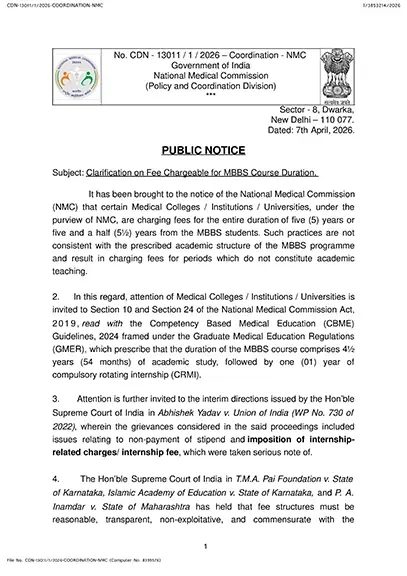
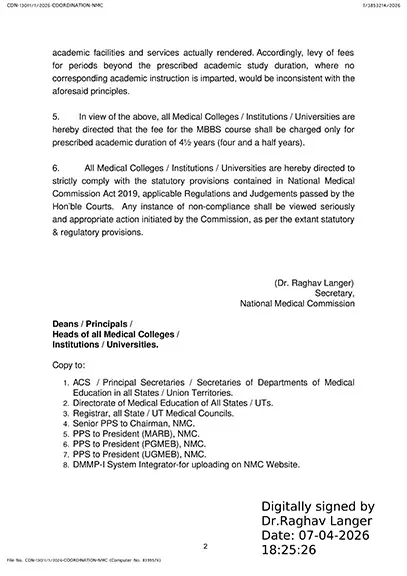
The National Medical Commission issued a clear directive on April 7, 2026. Medical colleges in India cannot charge fees for the internship year. The NMC public notice April 2026 states that MBBS fees are valid only for 4.5 years of academic study - nothing more.
| Detail | Information |
|---|---|
| Notice Number | CDN-13011/1/2026 |
| Issued By | National Medical Commission |
| Date | April 7, 2026 |
| Fee Chargeable Period | 4.5 years academic study only |
| Internship Duration | 1 year CRMI - not billable |
| Non-Compliance | Regulatory action under NMC Act 2019 |
Many colleges were charging fees for 5 or 5.5 full years. NMC has now put a stop to it.
What Is the Actual Structure of MBBS in India?
Students and parents often confuse the total programme length with the fee-paying period. Here is the difference.
| Phase | Duration |
|---|---|
| Academic Study (CBME) | 4.5 years / 54 months |
| Compulsory Rotating Medical Internship (CRMI) | 1 year |
| Total Programme Length | 5.5 years |
| Fee Chargeable Period | 4.5 years only |
The MBBS course duration in India is 5.5 years in total. But only 4.5 years involve classroom teaching and clinical academic training. The final year is the Compulsory Rotating Medical Internship (CRMI) - a supervised service period. It is not academic instruction. Colleges have no right to bill it as one.
During CRMI, interns work in hospitals. They are entitled to a monthly stipend under CRMI Regulations 2021 - not a fee demand from their college.
What Law Backs This Order?
The NMC directive is not arbitrary. It rests on solid legal ground.
- NMC Act 2019, Section 10 and Section 24 set the academic structure and give NMC the power to regulate fees.
- CBME Guidelines 2024 under the Graduate Medical Education Regulations (GMER) define the 54-month academic period.
- The Supreme Court in T.M.A. Pai Foundation, Islamic Academy of Education v. State of Karnataka and P.A. Inamdar v. State of Maharashtra have held that the fee structure of medical colleges should be reasonable, open and not exploitative.
- In the case of Abhishek Yadav v. Union of India (WP No. 730/2022), the Supreme Court paid a strong attention to the charges and non-payment of the stipend associated with internship.
Charging fees beyond the academic period directly violates all of the above.
Which Colleges Were Doing This and What Happens Now?
NMC confirmed that colleges under its purview were billing students for 5 or 5.5 full years. That means students paid tuition for the internship year - a year they were working in hospitals, not sitting in classrooms.
All medical colleges must now:
- Charge fees only for the 4.5-year MBBS academic period
- Stop collecting internship-year tuition immediately
- Comply with the NMC Act 2019, CBME Guidelines, and Supreme Court judgements
Non-compliance will be treated seriously. NMC has the authority to initiate regulatory action.
What This Means for You as a Student
Can medical colleges charge MBBS fees for the internship year?
No. The April 7, 2026 NMC notice explicitly prohibits it.
Does this apply to private medical colleges?
Yes. It applies to all colleges, institutions and universities under NMC purview. Both government and private colleges are affected.
Can my college charge a separate internship fee?
No. The Supreme Court flagged internship-related charges in the Abhishek Yadav case specifically.
Do I receive a stipend during CRMI?
Yes. According to CRMI Regulations 2021, interns are required to be given a monthly stipend.
Can I claim a refund if I already paid for 5 or 5.5 years?
The notice does not address past payments. But it establishes that overcharging was non-compliant. Students may raise this with their State Medical Council or the NMC directly.
Key Takeaway
The NMC fee directive 2026 is straightforward. Medical colleges can only charge fees for the 4.5-year academic period of MBBS. The one-year internship is not a teaching period. It cannot be billed as tuition. Any college that continues to do so faces action under the NMC Act 2019.
If your college charged you for 5 or 5.5 years, that practice is now officially non-compliant.